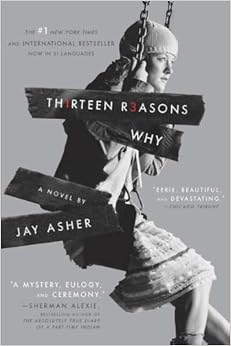
13 Reasons Why
13 Reasons Why by Jay Asher, ISBN 978-1-59514-171-2, Penguin Books 2007
Plot Summary:
The story centers on the life of Hannah Baker, as told to her friend Clay Jensen through a series of 13 cassette tapes. Clay is a quiet and sensitive teenager who comes home after school one day to find an anonymous package on his doorstep. Inside, he finds cassette tapes recorded by Hannah before she committed suicide by overdosing. Through listening, Clay realizes he is one of 13 people to receive her story. When Clay is done with his tape, he is to send it one to the next person on the list, so on and so on. If the tapes are not listened to by the recipients, Hannah has made copies and given them to another friend who has been instructed to release the tapes to the whole school. In the tapes, Hannah outlines thirteen different reasons why she decided to kill herself. The stories involve various actions of Hannah’s classmates and some actions of Hannah’s own. Clay spends all night listening to the tape and going to locations that Hannah pinpoints as specific to her story. He tries to discover what circumstances led his crush to take her own life.
Critical Evaluation:
The narration of the story works well. By using Hannah’s words in italics and Clay’s thoughts and experiences in regular text, the reader is allowed to see the story from two different angles. Asher is able to convey Clay’s pain at being left behind and Hannah’s building pain that caused her to take her own life. The heart of the story is how seemingly inconsequential actions can have lasting effect .Instead of making Hannah a complete victim, Asher gives the reader some insight into her own guilt at causing others pain, which only increases her desire to end her life. This can make the book a little hard to read. By showing how an action causes a reaction, readers are forced to think of their own daily choices and how they affect the lives of others, something they might not be thinking of already. The pace is fast and the language is easy to read for any teenager. Many people deal with real regret for the first time in their teenage years, so the regret and pain felt by Hannah and the other characters will certainly resonate with teen readers. The scene with Mr. Porter leaves a little to be desired. It’s hard to imagine that any educator would simply ignore a child who admits to having suicidal thoughts. While those thoughts may be common, I doubt any person in Mr. Porter’s position wouldn’t take it at least somewhat seriously. This book is a good read for any teenager. It’s the time in their lives when they really have to start thinking about how their day to day decisions affect not only their own lives, but those of the people around them.
Reader’s Annotation:
Hannah Baker wants everyone to know what caused to take her own life. Can she make any kind of change with her parting words?
Information about the Author:
Except for six months in Wyoming, I've lived my entire life in California. It was during those six months in Sheridan, Wyoming that I came up with the idea for Thirteen Reasons Why. I've worked at an independent bookstore, a chain bookstore, an outlet bookstore, and two public libraries. Before those jobs, I worked at a shoe store, a trophy shop, and an airline. My very first writing award earned me a free fruit smoothie every day for a year. I've won a lot of awards since then, but that one tasted the best!
Genre:
Coming of age, mystery
Curriculum Ties:
Suicide, mental illness, treating others with compassion
Challenge Issues:
Any book dealing with the suicide of a teenager is bound to be challenged.
Any book dealing with the suicide of a teenager is bound to be challenged.
Creating a Defense:
- Make sure you have thorough knowledge of the library’s selection policy as well as a copy on hand. Your insight as well as pointing out specific portions of the policy will be helpful in discussion with the patron.
- Always have the library Bill of Rights close to show the patron your library’s commitment to providing all kinds of information.
- Make sure you’re familiar with the books that might be challenged. Be prepared to discuss the book’s intended audience, its educational significance, purpose, and also some alternative titles to read.
- Don’t get defensive. The librarian can’t take the challenge personally and either party getting upset will cause the discussion to devolve into a fight.
- LISTEN. Even if you don’t agree with the patron, their views are as valid as yours and should be respected.
Reading Level:
Ages 12+
Booktalking Ideas:
Have you ever had, or known someone who has had, suicidal thoughts? Do you think about the potential consequences of your actions?
Why is the material included?:
This book is an easy read so captivating that most teens would find enjoyment in it regardless of reading ability.
Image via Google
Image via Google

No comments:
Post a Comment