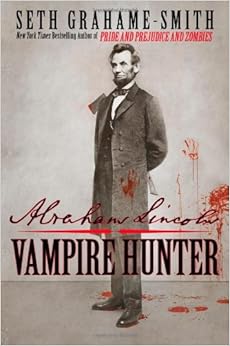
Abraham Lincoln: Vampire Hunter
Abraham Lincoln: Vampire Hunter by Seth Grahame Smith, ISBN 978-0-446-56308-6, Grand Central Publishing 2010
Plot Summary:
This semi-fictional work starts with Abraham Lincoln as a young boy. He learns that both his grandfather are his mother were killed by vampires. Lincoln swears as a young child that he would kill as many vampires as he could. Lincoln is hunting vampires when he is nearly killed by one. His life is saved by a man who calls himself a “good” vampire, Henry Sturges. Henry nurses Lincoln back to health and trains him to become a ruthless vampire killer. For a while, the two separate. Henry sends Lincoln names of vampires to kill, and Lincoln finds them and kills them. Lincoln travels down the Mississippi River and is present at a slave auction. It is here that Lincoln realizes that the slaves are being sold to a vampire slave owner to be used for food. In light of this realization, Lincoln begins an illustrious political career focused on ending slavery and banishing vampires from American once and for all
Critical Evaluation:
The novel is set up so that the author has been given the journals of Abraham Lincoln by Henry, who is still alive in the 21st century. The language can be tough at times, since Lincoln speaks in the 19th century vernacular and the story is littered with quotes from Shakespeare and other authors from earlier times. Other than that, this novel is a fast read and should thrill any reader who loves both history and fantasy fiction. What works most about the book is how Grahame Smith is able to weave a fictional vampire story with some very well researched true biographical information about Abraham Lincoln.The president’s most memorable life events are present, like his famous debates with Stephen Douglas and his unlikely but successful political career. What doesn’t work for me is the vampire/slavery part of the book. There has been much debate in the past about the true basis of the Civil War and Lincoln’s intentions when signing the Emancipation Proclamation, but in this story, Lincoln only becomes an abolitionist in order to end the rule of Vampires in the American South. He is still trying to free the slaves, but it’s not clear whether this fictional Lincoln would have do so if he wasn’t aiming to take away the vampires’ main source of nutrition.
Reader’s Annotation:
You think you’ve heard everything you need to know about Abraham Lincoln. What you don’t know will shock you and paint our 16th president in a much different light.
Information about the Author:
Seth Grahame Smith is a New York Times bestselling author, and a screenwriter, producer and director of film and television.
In 2009, Seth single handedly created the mash up craze with his novel Pride and Prejudice and Zombies, which debuted at #3 on the New York Times bestseller list. It’s since sold over two million copies and been translated into more than twenty languages. A feature film adaptation is set for 2015.
In 2010, Seth co-created and produced MTV’s first live action comedy, The Hard Times of RJ Berger, which ran for two seasons. That same year, his follow up novel, Abraham Lincoln: Vampire Hunter, debuted at #4 on the Times list, also going on to sell more than two million copies. Tim Burton purchased the film rights to Lincoln and hired Seth to adapt it for the big screen. Seth’s script was selected to the Black List in 2011.
In 2012, Warner Brothers bought the film rights to Seth’s third straight New York Times bestseller,Unholy Night, in a record-setting deal. He’s currently adapting the book for the screen, and producing the film with David Heyman (the Harry Potter series).
Genre:
Historical thriller, fantasy fiction, semi-biography
Curriculum Ties:
History
Challenge Issues:
This book could be challenged because of it’s violence and for rewriting the history of a beloved figure.
Creating a Defense:
- Make sure you have thorough knowledge of the library’s selection policy as well as a copy on hand. Your insight as well as pointing out specific portions of the policy will be helpful in discussion with the patron.
- Always have the library Bill of Rights close to show the patron your library’s commitment to providing all kinds of information.
- Make sure you’re familiar with the books that might be challenged. Be prepared to discuss the book’s intended audience, its educational significance, purpose, and also some alternative titles to read.
- Don’t get defensive. The librarian can’t take the challenge personally and either party getting upset will cause the discussion to devolve into a fight.
- LISTEN. Even if you don’t agree with the patron, their views are as valid as yours and should be respected.
Reading Level:
Grades 9-12
Booktalking Ideas:
Do you think there’s more to historical figures than we know?
Why is the material included?:
I’ve been a fan of Grahame Smith’s for a while.While the novel is not really a biography, I think teenagers would find it fun to read some fiction about a historical figure they’ve heard about for so long. They might even learn some true facts from the book.
Image via Google
Image via Google

No comments:
Post a Comment