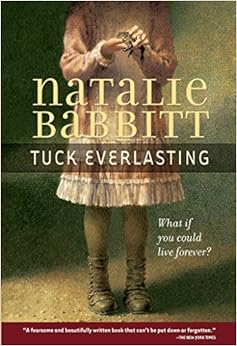
Tuck Everlasting
Tuck Everlasting by Natalie Babbitt, ISBN 978-0312369811, Farrar, Straus and Giroux 1975
Plot Summary:
The story opens with ten year old Winnie Foster living in the small town of Treegap. Winnie is bored in the small town and is tired of her family, so she decides to run away. On her journey, she runs in a 17 year old boy named Jesse Tuck. Jesse is drinking from a spring and Winnie wants to as well, but Jesse will not let her. Jesse takes Winnie to his family home to meet his brother, Miles, his mother, Mae, and his father, Angus. The Tucks are being followed by a character known as the man in the yellow suit. The Tucks explain to Winnie that the spring has magical powers and give any drinker eternal life. The man in the yellow suit has followed the Tucks home and hears their conversation with Winnie. The man plans to sell the water to the townspeople to get rich. In the struggle to keep the stream a secret, the Tucks must eventually leave Treegap. Jesse leaves Winnie with a bottle of the spring water and tells her that she can drink it when she’s 17 so she can find Jesse and marry him. When the Tucks are gone, Winnie must decide whether eternal life would really be worth it.
Critical Evaluation:
Babbitt creates a fully formed world and the the reader will have no trouble believing that the Tucks really do have access to eternal life. The language in the story evokes metaphors about the circle of life: seasons pass, the Ferris wheel pauses at the top. These images help the reader to see that the Tucks are stuck at a certain point in the circle and will never be able to fully complete it. A few plot points didn’t quite work for me, though. The Tucks have been alive for longer than any normal human, but they don’t seem to have grown or learned at all from their experiences. In other fiction concerning immortals, such as Anne Rice’s Interview with A Vampire, the main character uses his/her innumerable years to discover truths about themselves and the human condition. The Tucks seem content to live their lives almost exactly the way they had before they had eternal life. Another plot element that might bother some readers is Winnie’s choice to pour out the water that Jesse gave her, forsaking eternal life. Babbitt, I’m sure, was trying to make the point that eternal life is not as great as it seems to be, but I imagine that many readers will be disappointed that Winnie doesn’t take a chance on being with Jesse forever, since their relationship is the main focus of the book.
Reader’s Annotation:
Winnie has a chance to live forever. Will she take a leap of faith or keep both feet on the ground?
Information about the Author:
I was born and raised in Ohio. During my childhood, I spent most of my time drawing and reading fairy tales and myths. My mother, an amateur landscape and portrait painter, gave me art lessons. She always made sure I had enough paper, paint, pencils, and encouragement. I grew up wanting only to be an illustrator. I studied art at Laurel School in Cleveland and at Smith College.
Right after graduation, I married Samuel Fisher Babbitt, an academic administrator. I spent the next ten years in Connecticut, Tennessee, and Washington, D.C., raising our children, Christopher, Tom, and Lucy.
My husband took time out from his academic career to write a novel and discovered that he didn't enjoy the long, lonely hours that writing demanded. My sister produced a comic novel, which required substantial rewriting. I learned three valuable things from observing my husband's and sister's forays into the writer's world: You have to give writing your full attention. You have to like the revision process. And you have to like to be alone. But it was years before I put any of this to good use.
In 1966, my husband and I collaborated on a children's book called The Forty-ninth Magician he wrote it and I illustrated it. With encouragement from our editor at Farrar, Straus & Giroux, I continued producing children's books even after my husband became too busy to write the stories.
I write for children because I am interested in fantasy and the possibilities for experience of all kinds before the time of compromise. I believe that children are far more perceptive and wise than American books give them credit for being.
Genre:
Fantasy, Romance
Curriculum Ties:
Making tough choices, definition of a hero, definition of family
Challenge Issues:
This book could be challenged for its inclusion of violence and “unnatural” eternal life.
Creating a Defense:
- Make sure you have thorough knowledge of the library’s selection policy as well as a copy on hand. Your insight as well as pointing out specific portions of the policy will be helpful in discussion with the patron.
- Always have the library Bill of Rights close to show the patron your library’s commitment to providing all kinds of information.
- Make sure you’re familiar with the books that might be challenged. Be prepared to discuss the book’s intended audience, its educational significance, purpose, and also some alternative titles to read.
- Don’t get defensive. The librarian can’t take the challenge personally and either party getting upset will cause the discussion to devolve into a fight.
- LISTEN. Even if you don’t agree with the patron, their views are as valid as yours and should be respected.
Reading Level:
10-14 years
Booktalking Ideas:
What would you do if someone offered you eternal life? How would you spend your time if you could live forever?
Why is the material included?:
The book is mainly aimed at younger readers, but a film came in in 2002 that starred older teens and made more older teenagers interested. The book is good for slow readers.
Image via Google
Image via Google

No comments:
Post a Comment