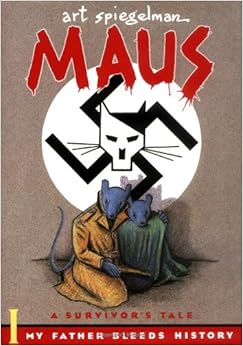
Maus
Maus I: A Survivor’s Tale: My Father Bleeds History by Art Spiegeleman, ISBN 978-0394747231, Pantheon Books 1991
Plot Summary:
In this nonfiction work, Art Spiegelman talks with his father, Vladek, about the family’s experiences during World War II as Polish Jews facing persecution. The story weaves in and out of the present day interview, which takes place in 1978-9 and Vladek’s memories of wartime in Poland from the mid 1930s to 1945. Vladek describes how he met Art’s mother, Anja, in Poland and married into her wealthy family. They move to Anja’s hometown and Vladek becomes a manufacturer. In present day, Vladek asks Art not to put this in the book and he reluctantly agrees. Anja gives birth to their first son, Richieu, and suffers postpartum depression afterward. While trying to hide from the increasing Nazi presence, Vladek and Anja send Richieu to live with his aunt in another city. When that city is overtaken, the aunt poisons herself, her children, and Richieu in order to avoid being captured. Before Anja commits suicide in 1968, she gives her journals from the war to Vladek and asks that Art receive them when the time is right. Vladek burns them instead. Art and Vladek have spent many years trying to reconnect and establish a better relationship, and Art is hoping that getting their history out in the open will help.
Critical Evaluation:
This is not an easy read. The words are easy to understand, but every character in the novel holds on to so much anger and resentment that it’s a little hard to get through the story. The narrator and artist, Art, has lived with a lot of frustration with his father and it’s only through finally hearing his father's account of the war that Art is able to find some common ground and maybe even forgiveness. Guilt is one of the major emotions in the book. Art feels guilty over his brother’s fate, even though there was nothing he could do to change it. Vladek feels guilty over Anja’s death. The two men have more in common emotionally than either of them realizes, and the mutual understanding that they begin to share is definitely a highlight of the book. One of the most striking elements of the book is Art’s choice to anthropomorphize the characters in the past. Each ethnicity comes with its own animal that is supposed to represent the nature of their people. The Jews are mice, quiet and meek and scared. The Germans are, somewhat obviously, cats who prey on the mice. Some might see the metaphor as basic, but the intended audience will likely enjoy the visuals that help distinguish each group of people in the book so that the reader knows exactly which side each character is on.
Reader’s Annotation:
Art and his father can never see eye to eye in the present. Will looking into the past help father and son mend?
Information about the Author:
Art Spiegelman (born Itzhak Avraham ben Zeev on February 15, 1948) is an American cartoonist, editor and comics advocate best known for his graphic novel Maus. His work as co-editor on the comics magazines Arcade and Raw has been influential, and from 1992 he spent a decade as contributing artist for The New Yorker, where he made several high-profile and sometimes controversial covers. He is married to designer and editor Françoise Mouly, and is the father of writer Nadja Spiegelman.
Spiegelman began his career with the Topps bubblegum card company in the mid-1960s, which was his main financial support for two decades; there he co-created parodic series such as Wacky Packages in the 1960s and the Garbage Pail Kids in the 1980s. He gained prominence in the underground comix scene in the 1970s with short, experimental, and often autobiographical work. A selection of these strips appeared in the collection Breakdowns in 1977. After Breakdowns, Spiegelman turned focus to book-length Maus, about his relation with his father, a Holocaust survivor. The postmodern book depicts Nazis as cats, Jews as mice, and ethnic Poles as pigs, and took thirteen years until its completion in 1991. It won a special Pulitzer Prize in 1992 and has gained a reputation as a pivotal work, responsible for bringing scholarly attention to the comics medium.
Spiegelman and Mouly edited eleven issues of Raw from 1980 to 1991. The oversized comics and graphics magazine helped introduce talents who became prominent in alternative comics, such as Charles Burns, Chris Ware, and Ben Katchor, and introduced several foreign cartoonists to the English-speaking comics world. Beginning in the 1990s, the couple worked for The New Yorker, which Spiegelman left to work on In the Shadow of No Towers (2004), about his reaction to the September 11 attacks in New York in 2001.
Spiegelman is an advocate for greater comics literacy. As editor and as a teacher at the School of Visual Arts in New York City, Spiegelman has promoted better understanding of comics and has mentored younger cartoonists.
Genre:
Graphic novel, historical nonfiction, family drama
Curriculum Ties:
WWII studies, family dynamics
Challenge Issues:
The book could be challenged because of its perceived racism; each ethnicity is represented by a different animal and the characterizations are not always flattering.
Creating a Defense:
- Make sure you have thorough knowledge of the library’s selection policy as well as a copy on hand. Your insight as well as pointing out specific portions of the policy will be helpful in discussion with the patron.
- Always have the library Bill of Rights close to show the patron your library’s commitment to providing all kinds of information.
- Make sure you’re familiar with the books that might be challenged. Be prepared to discuss the book’s intended audience, its educational significance, purpose, and also some alternative titles to read.
- Don’t get defensive. The librarian can’t take the challenge personally and either party getting upset will cause the discussion to devolve into a fight.
- LISTEN. Even if you don’t agree with the patron, their views are as valid as yours and should be respected.
Reading Level:
Grades 8+
Booktalking Ideas:
Do you get along with your family? How would you cope if a tragedy happened within your family? Do you have any relatives who can remember what life is like during wartime?
Why is the material included?:
I read this for the first time in my undergraduate studies. I really enjoyed the personal story of Jews in WWII and this felt new even though those stories are told often.
Image via Google
Image via Google

No comments:
Post a Comment