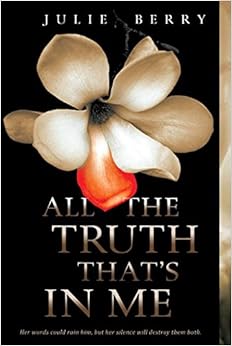
All the Truth That’s In Me
All the Truth That’s in Me by Julie Berry, ISBN 978-0142427309, Speak 2014
Plot Summary:
18 year old Judith lives in an unnamed time and place. She lives in a small village reminiscent of Colonial America, but the setting is never confirmed. It is revealed the Judith and her friend, Lottie, had been kidnapped from the village and Judith had returned two years prior. Judith had returned to her village without Lottie, who is revealed to be dead. Judith’s tongue has been cut out, leaving her unable to tell the people of the village what actually happened to her. Even after all of her suffering, Judith returns to find a less than welcoming village. The townspeople are not very nice to her, and even her own mother treats her awfully. Judith has loved Lucas, another boy in the community, for as long as she can remember and being reunited with him at least brings her some joy. Judith must learn how to communicate with the people around her so that she can find her voice and express her truth.
Critical Evaluation:
Berry’s novel is told in a second person perspective, which can be problematic for some readers. I definitely wouldn’t suggest this book for someone who isn’t a strong reader. I think this perspective works well for the story and gives the reader insight into the truth that Judith is trying to communicate. The “you” in the second person narrative is Judith’s long lost love, Lucas. There are many issues at play here, but the love story seems the most satisfying. It also seems to be involved because the intended audience is teenagers, and that’s something they can relate to. One of the main issues is the power of communication. There is inherent freedom in being able to express yourself, and Judith has had that freedom revoked. Her day to day life is full of confusion because she can’t express herself and therefore, the townspeople don’t understand her. And mostly, they don’t want to. Their reactions to and ideas about Judith give the novel it's distressing mood. Even after being returned home, Judith finds safety and comfort elusive. Despite her physical punishment, Judith is portrayed as a heroine throughout the novel. Berry gives Judith strength and courage. Judith finds a certain freedom in being an outsider of the town, and is able to discover and explore because nobody’s really ever paying attention to her. I think this book could have easily been dismissed as another novel where a young woman is violently hurt and then has to find her way back to normalcy, but Berry’s characters are richly developed and the reader is not encouraged to pity Judith.
Reader’s Annotation:
Judith has faced unspeakable horrors. Unspeakable because she no longer has the ability to do so. How will she find her voice and spread her truth?
Information about the Author:
I grew up on a 50-acre farm in Western New York as the youngest of seven children. We grew much of our own food and harvested eggs from our chickens. We also kept turkeys, pigs, rabbits, and oodles of dogs and cats. I was free to ramble around our pond full of frogs and turtles, and wade in our crick full of minnows and crawdads. I was lucky to be the caboose kid in a big family full of avid readers, with a mother who loved poetry.
I had a perfect little library of children’s classics to reread to my heart’s content. I think I came close to memorizing Charlotte’s Web, the Little House books, the Great Brain series, Anne of Green Gables, Little Women, The Secret Garden, Just So Stories, Heidi, Alice in Wonderland, and A Little Princess.
In high school I filled my time with clubs, sports (volleyball, track, cross country), music lessons and singing, babysitting and jobs (YMCA), friends, and still, books. College was much the same – more volleyball, more friends, more jobs (slinging pizza, making copies). I attended Rensselaer Polytechnic Institute in Troy, NY, where I majored in communication.
I dreamed of being many things – a marine biologist, a chemist, a mother, a gymnast, a Solid Gold Dancer – but always, writing was on the back of my mind. Whatever else I might be or do, I hoped writing would be part of the mix.
In college I met my husband Phil. We married young and started our family soon after. Now we’re the parents of four boys, including three teenagers, and we don’t know where the time went. To keep the gender balance more even in our home, we have two girl cats.
After my fourth son was born, I decided that since my family dreams were now well underway, it was time to pursue writing novels. I went back to school and earned an M.F.A. in writing for children and young adults from Vermont College of the Fine Arts, where I learned from many talented and committed writers for young people. The Amaranth Enchantment was the second novel I wrote in school, and the first one to sell to a publisher. Since then I’ve written Secondhand Charm, All the Truth That’s In Me, and the Splurch Academy for Disruptive Boys series with my older sister, Sally Faye Gardner, as the illustrator. All the Truth That’s In Me, my first YA novel, is my most recent release. It’s a 2013 Horn Book Fanfare title, a School Library Journal Best of 2013 book, and a Kirkus Best Teen Read for 2013. It has been named a Junior Library Guild Selection and has been nominated for a Carnegie Medal and a YALSA Best Fiction for Young Adults award, and will be published in 12 countries internationally. My next novel, a middle grade titled The Scandalous Sisterhood of Prickwillow Place, will be published in September 2014 in the US by Roaring Brook, in Germany by Theinemann Verlag GmbH, in the UK by Piccadilly Press, and in Brazil by Editora Rocco.
Now I’m home full-time, keeping the cats company by day while I write, and chasing the boys around in the afternoons and evenings. If you want to know if I’m working on another book now, the answer is always, “Yes.”
Genre:
Mystery, historical fiction, Coming of age
Curriculum Ties:
Outcasts, Violence against women, young love
Challenge Issues:
This book could be challenged because of its depiction of violence against young girls.
Creating a Defense:
- Make sure you have thorough knowledge of the library’s selection policy as well as a copy on hand. Your insight as well as pointing out specific portions of the policy will be helpful in discussion with the patron.
- Always have the library Bill of Rights close to show the patron your library’s commitment to providing all kinds of information.
- Make sure you’re familiar with the books that might be challenged. Be prepared to discuss the book’s intended audience, its educational significance, purpose, and also some alternative titles to read.
- Don’t get defensive. The librarian can’t take the challenge personally and either party getting upset will cause the discussion to devolve into a fight.
- LISTEN. Even if you don’t agree with the patron, their views are as valid as yours and should be respected.
Reading Level:
Grades 9-12
Booktalking Ideas:
Have you ever felt like you had something you couldn’t communicate? How would you express yourself if you had no voice?
Why is the material included?:
I love this heroine. There are so many YA books now about strong girls, but Judith has a mental toughness that I just adore. I think lots of teens will love this book.
Image via Google
Image via Google

No comments:
Post a Comment