13 Reasons Why
1989
Abraham Lincoln: Vampire Hunter
All the Truth That's In Me
Apples to Apples
Ash
Awkward Family Photos
Big Fat Disaster
Black Hole
The Body of Christopher Creed
The Book Thief
The Breakfast Club
Bring It On
Britannica Online
The Catcher in the Rye
Clueless
The Craft
Dazed and Confused
Emmy and Oliver
The Fault in Our Stars
The First Part Last
Freakboy
Go Ask Alice
The House on Mango Street
The Hunger Games Trilogy
Let Go
Luna
Maus
The Outsiders
The Perks of Being a Wallflower
Persepolis
Pretty Little Liars
Pride and Prejudice and Zombies
The Princess Diaries
ProQuest
Rolling Stone
Say Anything
A Separate Peace
Seventeen Magazine
Teen Ink
Teen Vogue
To Kill a Mockingbird
Tuck Everlasting
The Twilight Series
Up All Night
Wednesday, August 5, 2015

Britannica Online

Britannica Online
Database Summary:
This database contains the entire Encyclopedia Britannica. It can be used for any kind of research on any kind of subject. The homepage is divided into the regular encyclopedia and Britannica Kids, which allows younger children to research as well.
Critical Evaluation:
This database is extremely easy to use. The only downfall is that you have to pay to use it. There’s a 7 day free trial, but that’s the only way to use the database without paying upwards of $70 a year.
Curriculum Ties:
All subjects
Challenge Issues:
n/a
Intended Audience:
All ages
Why is the material included?:
This encyclopedia used to be my go to when I was kid.
Image via Google
ProQuest

Proquest
Database Summary:
Proquest exists to help in academic research. The database contains links and full texts for millions of dissertations, theses, newspapers, archived newspapers, periodicals, government archives, and aggregated databases. The main objective is to connect a student with the proper research to help write an academic paper.
Critical evaluation:
Proquest is a lifesaver. I have used this database so many times in both my undergraduate and graduate studies. It’s so easy to use. The homepage is broken down into links specific to libraries, researchers, customers, and publishers/partners. Once inside the database, the user can easily specify their needs through keyword, title, author, or subject matter and instantly access all the information they need to complete their work.
Curriculum Ties:
Any and all subjects
Challenge Issues:
Because it’s a database, Proquest links to any kind of information available on the web, some which might be deemed controversial.
Creating a Defense:
- Make sure you have thorough knowledge of the library’s selection policy as well as a copy on hand. Your insight as well as pointing out specific portions of the policy will be helpful in discussion with the patron.
- Always have the library Bill of Rights close to show the patron your library’s commitment to providing all kinds of information.
- Make sure you’re familiar with the books that might be challenged. Be prepared to discuss the book’s intended audience, its educational significance, purpose, and also some alternative titles to read.
- Don’t get defensive. The librarian can’t take the challenge personally and either party getting upset will cause the discussion to devolve into a fight.
- LISTEN. Even if you don’t agree with the patron, their views are as valid as yours and should be respected.
Intended Audience:
Ages 16+
Why is the material included?:
I have never used a database more than I use this one.
Image via Google
Say Anything
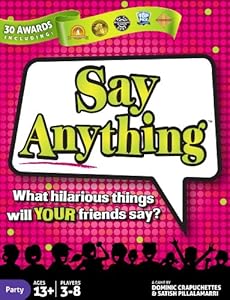
Say Anything
Say Anything. North Star Games.
Genre:
Teen Games
Game Summary:
This game has no right or wrong answers. It simply consists of subjective questions like, “What’s the best movie of all time?” and allows the players to start a dialogue or debate about what their answer might be. There is also no winner or loser. This game is just played for fun.
Critical Evaluation:
This game reminds me of the kind of game I used to play at slumber parties when I was little. The main objective is to get to know your friends better by asking all of them questions. The questions themselves are innocuous, but the game came easily take another direction if played with adults.
Curriculum Ties;
n/a
Challenge Issues:
n/a
Intended Audience:
Ages 13+
Why is the material included?:
I wish I’d had a game like this when I was a teenager!
Image via Google
Awkward Family Photos

Awkward Family Photos
Awkward Family Photos. All Things Equal, Inc.
Genre:
Card game/dice game
Game Summary:
How To Play
- Flip over a card, roll the 20-sided die, and read aloud the corresponding question.
- All players, except the roller, write down an answer. Answer sheets are collected and read aloud by the player to the right of the roller. The roller then picks a favorite answer and tries to guess which player said which answer.
- The player who wrote the favorite answer places one of their five chips on the board. If the roller matches two or more answers correctly, the roller also places a chip on the board. The first player to place all five of their chips on the board wins!
Critical Evaluation:
This game is fun although it actually has very little to do with awkward family photos. That’s just a small part of the game. It seems as though the makers of the popular website by the same name just wanted to market something else within their brain.
Curriculum Ties:
n/a
Challenge Issues:
n/a
Intended Audience:
Ages 10+
Why is the material included?:
My sister always wants to play this game when I go to her house. It’s fun, despite the misnomer of a title.
Image via Google
Apples to Apples

Apples to Apples
Apples to Apples. Published by Mattel.
Genre:
Card game
Game Summary:
The game is divided into two sets of cards, one with nouns or phrases and one with adjectives. One person picks an adjective card and the rest of the players put the noun or phrase they think best describes this adjective. While not knowing who laid down which card, the initial card holder picks her favorite and the person who laid down that card gets the adjective card. The first to five adjective cards wins the game.
Critical Evaluation:
I’ve played this game many times. It’s fun to play with friends because there’s some pride in knowing which card your friend will use. There are some questionable cards that might make the game less that suitable for teenagers.
Curriculum Ties:
n/a
Challenge Issues:
Some risque language
Creating a Defense:
- Make sure you have thorough knowledge of the library’s selection policy as well as a copy on hand. Your insight as well as pointing out specific portions of the policy will be helpful in discussion with the patron.
- Always have the library Bill of Rights close to show the patron your library’s commitment to providing all kinds of information.
- Make sure you’re familiar with the books that might be challenged. Be prepared to discuss the book’s intended audience, its educational significance, purpose, and also some alternative titles to read.
- Don’t get defensive. The librarian can’t take the challenge personally and either party getting upset will cause the discussion to devolve into a fight.
- LISTEN. Even if you don’t agree with the patron, their views are as valid as yours and should be respected.
Intended Audience:
Ages 12+
Why is the game included?:
It’s such a fun party game.
Image via Google
Rolling Stone

Rolling Stone
Rolling Stone. Jann Wenner. ISSN 0035-791X
Genre:
Music/Politics/Current Events
Magazine Summary:
Rolling Stone exists to not only review music and interview artists, but has become known for in depth interviews with political figures as well. The magazine covers all kinds of current event issues including presidential races, wartime coverage, and political interviews as well as profiles of the most famous musicians of the past 50 years.
Critical Evaluation:
This magazine has been beloved by teenagers since it's inception and has been a guiding influence in the careers of musicians and politicians alike.It gives teenagers in depth news that they (until the age of the internet) could not have gotten most anywhere else. It speaks to teenagers in a language they can understand about issues they might not.
Information about the publisher:
In 1967, a 20-year-old Jann S. Wenner dropped out of the University of California Berkeley to start a quirky rock-music-oriented biweekly called Rolling Stone—and changed American culture. Treating the interests of America’s increasingly vocal youth with seriousness unknown before, Rolling Stone spoke to—and for—an entire generation. Throughout its illustrious history, Wenner’s commitment to quality journalism has kept Rolling Stone fresh and dynamic—the magazine’s success has proved a new readership is always ready to respond to definitive music coverage, provocative interviews, award-winning photography and important investigative and political reporting. The magazine has won 14 National Magazine Awards for General Excellence, Design, Photography, Visual Excellence, Specialized Journalism, Feature Writing, and Reporting. Today, Rolling Stone continues to reign at the forefront of American journalism, and with 12 million readers it serves as the ultimate source for music information and popular-culture trends.
Curriculum Ties:
Politics/Current events
Challenge Issues:
Language
Language
Creating a Defense:
- Make sure you have thorough knowledge of the library’s selection policy as well as a copy on hand. Your insight as well as pointing out specific portions of the policy will be helpful in discussion with the patron.
- Always have the library Bill of Rights close to show the patron your library’s commitment to providing all kinds of information.
- Make sure you’re familiar with the books that might be challenged. Be prepared to discuss the book’s intended audience, its educational significance, purpose, and also some alternative titles to read.
- Don’t get defensive. The librarian can’t take the challenge personally and either party getting upset will cause the discussion to devolve into a fight.
- LISTEN. Even if you don’t agree with the patron, their views are as valid as yours and should be respected.
Intended Audience:
Ages 15+
Why is the material included?:
This magazine has been around since the late 1960s and has given teenagers access to information about their favorite artists and political figures since. I used to wait so impatiently every month for my issue to arrive.
Image via Google
Subscribe to:
Comments (Atom)